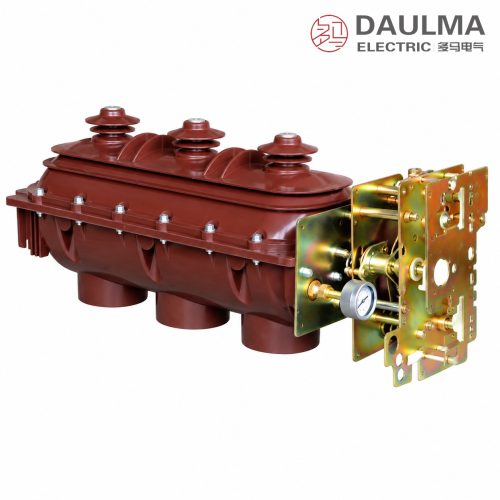
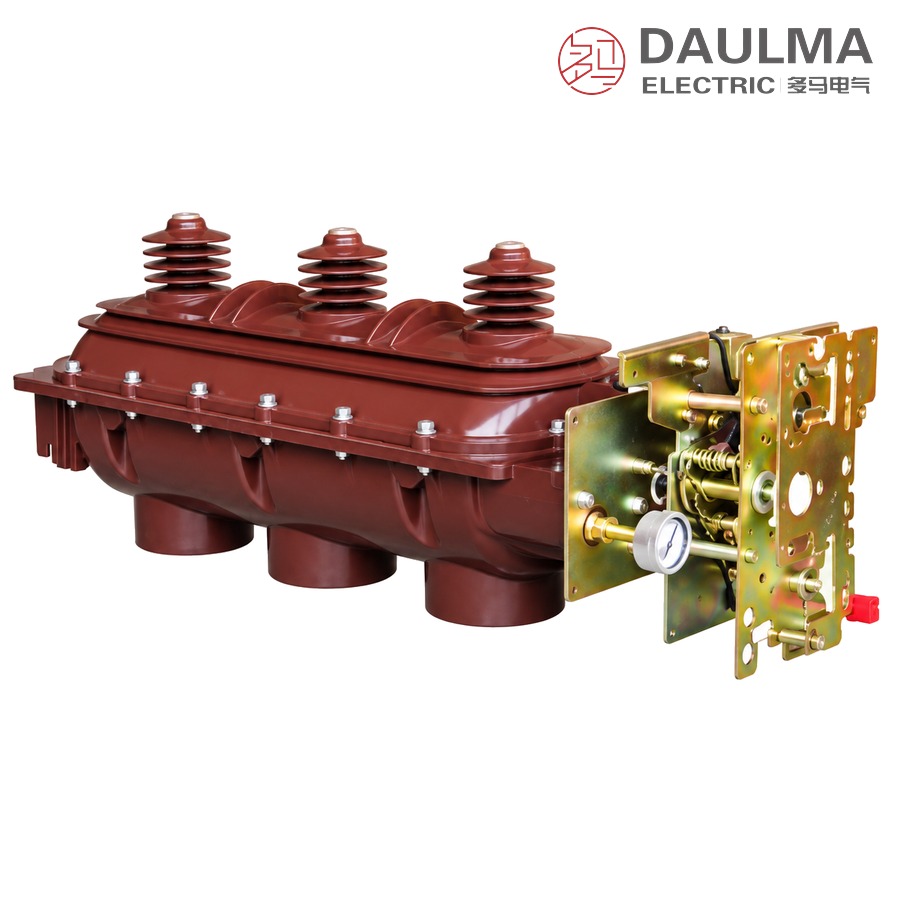
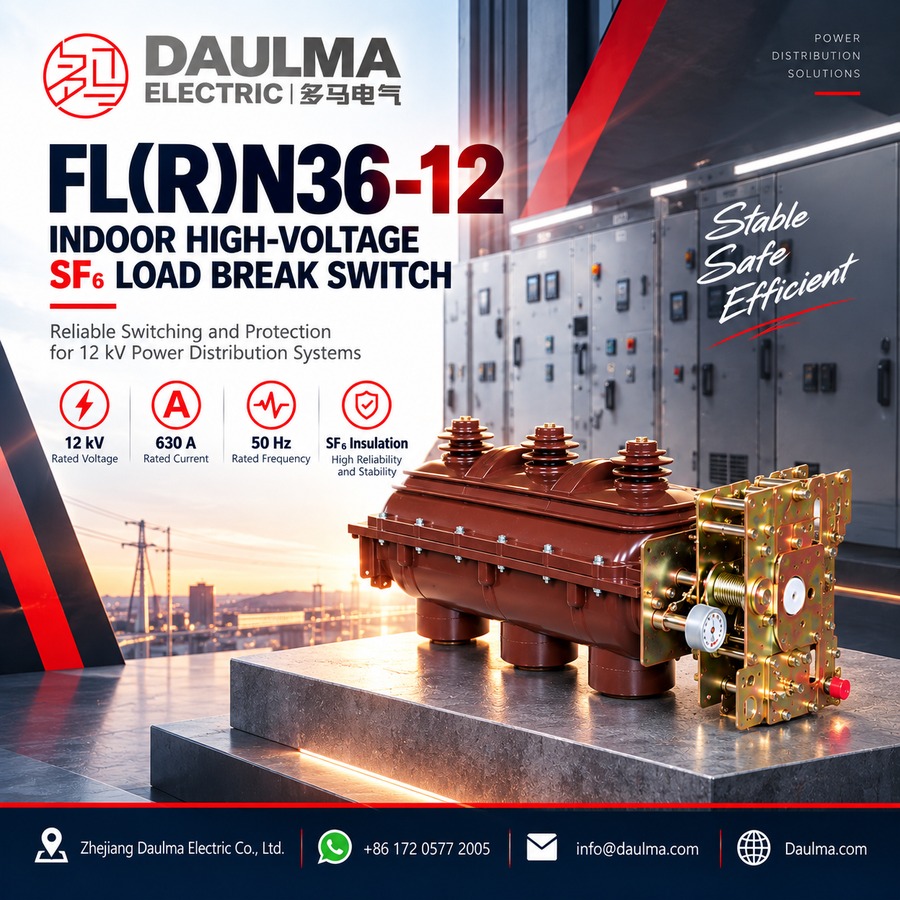
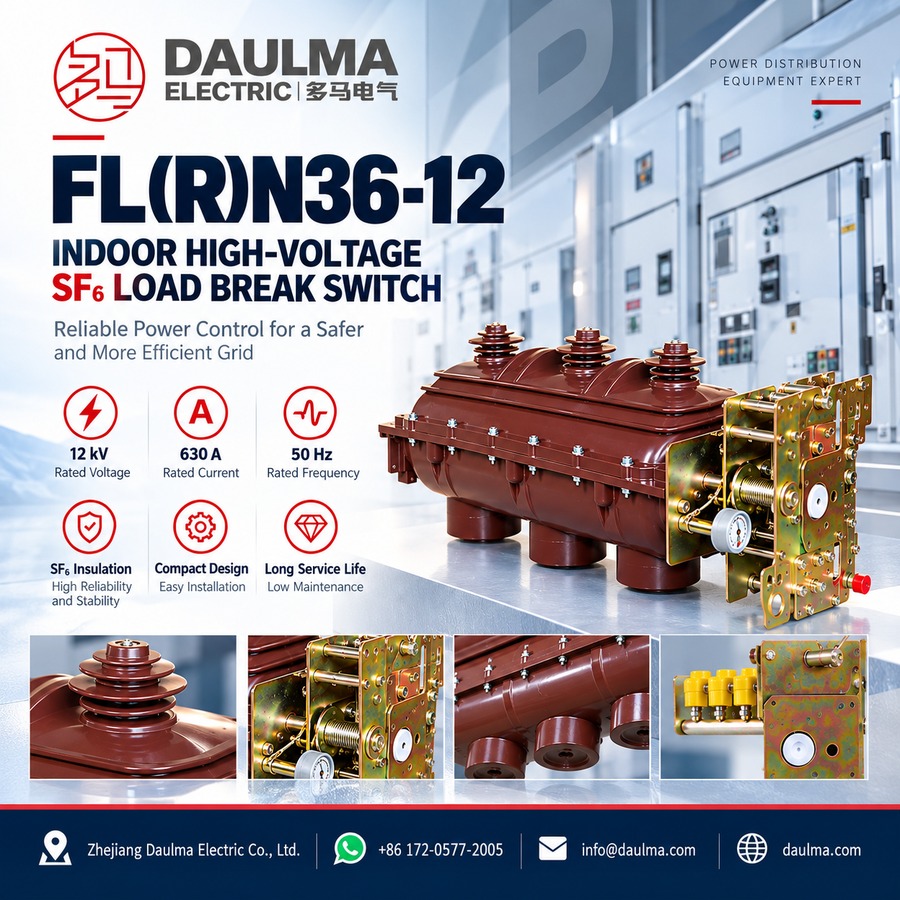
The FLN36-12 indoor high-voltage SF6 load break switch is a three-phase switching device for 10/12 kV, 50 Hz distribution systems, developed from absorbed foreign technology and built to local operating requirements. Full type tests confirm conformity with GB 3804 for 3-63 kV AC load break switches, GB 16926 for load break switch-fuse combination units, and IEC 60265 and IEC 60420.
The series covers the plain load break switch, the FLRN36-12 load break switch-fuse combination unit, and cable-head versions for cable branch boxes, so the same frame serves switching, isolation and earthing duties in urban networks, industrial plants, high-rise buildings, residential districts and package substations.
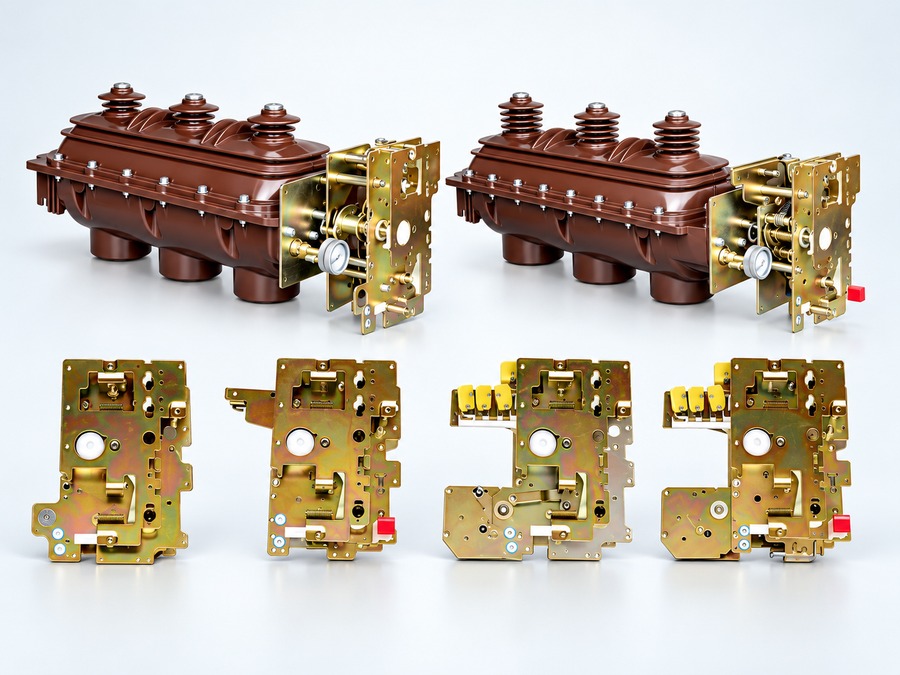
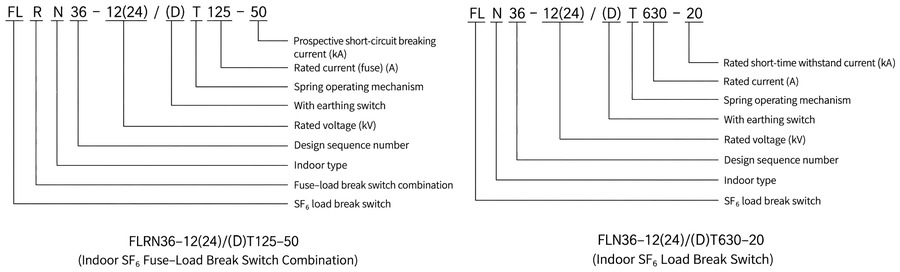
Model Designation
Other voltage, current and fuse combinations are available on request.
Construction and Design
The three poles are carried on a steel frame with epoxy insulator columns and house a sealed SF6 interrupter with on-off-earth three-position action and reliable interlocking. The design gives high break-point insulation and a large creepage distance, with a grading shield covering the outgoing terminals, and dynamic and static seals keep the gas chamber tight while a clearly visible pressure gauge allows the sealed system to be monitored in service. Versions for cable heads accept touch-safe elbow connectors on the outgoing terminals for use in cable branch and ring main units.
Operating Function and Application
In service the switch makes and breaks rated load current; it does not break short-circuit current, which is cleared by the back-up fuse of the FLRN36-12 combination unit or by upstream protection. The earthing switch position provides a solidly earthed, visibly indicated safe state for maintenance. Typical duties are feeder and transformer control and protection in 10/12 kV indoor switchgear, with 24 kV versions available on request.
Technical Parameters
Service Conditions
- Ambient temperature: +40℃ maximum, -25℃ minimum
- Altitude: Not more than 1000m
- Relative humidity: Daily average not more than 95%, monthly average not more than 90%
- Seismic intensity: Not more than 8 degrees
- Site condition: No fire, explosion, chemical corrosion or severe vibration
- Pollution level: II
Technical Data — FLN36-12 Load Break Switch
| No. | Item | Unit | Parameter |
|---|---|---|---|
| 1 | Rated voltage / highest voltage | kV | 10/12 |
| 2 | Rated current | A | 630 |
| 3 | Rated short-time withstand current (3 s) | kA | 20 |
| 4 | Rated peak withstand and short-circuit making current | kA | 50 |
| 5 | Power-frequency / lightning impulse withstand voltage | kV | 42/75 |
| 6 | Mechanical life | operations | 3000 |
| 7 | Rated SF6 gas pressure | MPa | 0.045 |
Technical Data — FLRN36-12 Load Break Switch-Fuse Combination Unit
| No. | Item | Unit | Parameter |
|---|---|---|---|
| 1 | Rated voltage / highest voltage | kV | 10/12 |
| 2 | Rated current of the fuse | A | 125 |
| 3 | Rated short-circuit breaking current | kA | 31.5 |
| 4 | Rated short-circuit making current | kA | 80 |
| 5 | Rated transfer current | A | 2000 |
| 6 | Power-frequency / lightning impulse withstand voltage | kV | 42/75 |
| 7 | Mechanical life | operations | 3000 |
| 8 | Rated SF6 gas pressure | MPa | 0.045 |
Standards
- GB 3804 — AC high-voltage load break switches, 3 kV to 63 kV
- GB 16926 — High-voltage load break switch-fuse combination units
- IEC 60265 — Indoor high-voltage switch-disconnectors, fuses and switch-fuse combinations
- IEC 60420 — High-voltage alternating-current switch-fuse combinations
Installation & Wiring
Installation and Commissioning
- Mounting: the frame is fixed level inside the switchgear cubicle or ring main unit, and the earthing terminal is bonded to the earth grid with a dedicated conductor.
- Mechanism checks: verify the on-off-earth three-position indication and the interlocking action, confirm that the spring mechanism charges and releases smoothly, and check that the SF6 pressure gauge reads within the specified range.
- Before energization: carry out the power-frequency withstand test on the main circuit and check terminal positions and cable clearances against the approved outline drawing.
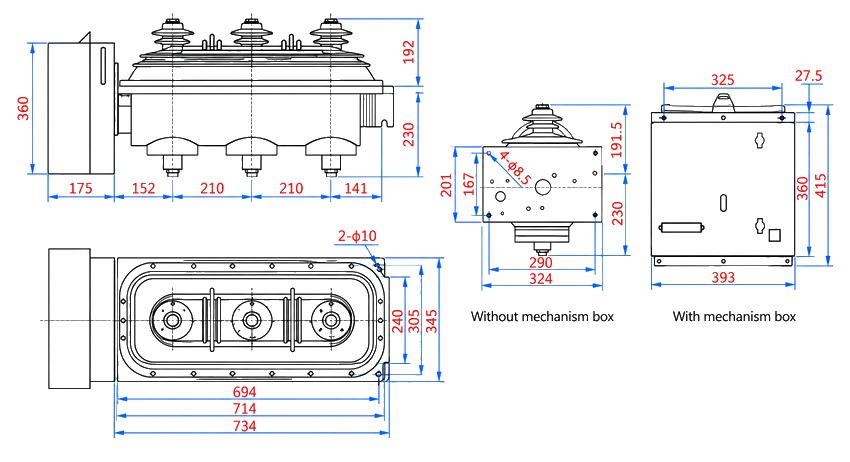
- Outline and mounting dimensions: the single pole is 360 mm high, 192 mm wide and 230 mm deep; the three-pole assembly is 694/714/734 mm wide for the 125 A, 200 A and 630 A units, with fixing centres of 240/305/345 mm and four Ø10 mm holes on the front flange and Ø8.5 mm holes on the side flange. Allow 325 mm depth for the cubicle when the spring mechanism box is fitted.
Applications
- Feeder and transformer switching in 10/12 kV indoor distribution switchgear
- Power distribution of industrial and mining enterprises and high-rise buildings
- Residential district distribution rooms and package substations
- Cable branch and ring main units with touch-safe cable elbow connectors
Selection & FAQs
Selection Guide
- State the rated voltage. The standard unit is 10/12 kV at 50 Hz; 24 kV insulation levels are available by agreement.
- Choose the switching unit or the combination unit. FLN36-12 carries and switches load current; FLRN36-12 adds back-up fuses that clear short-circuit faults up to 31.5 kA.
- Confirm the earthing requirement. The (D) suffix denotes the version with an earthing switch for the three-position on-off-earth scheme.
- Check the cable interface. Cable-head versions accept touch-safe elbow connectors for cable branch and ring main units; plain versions use bar or busbar connections.
- Verify the site conditions. Altitude above 1000 m, humidity beyond the listed averages or pollution level above II require a technical agreement.
FAQs
Q1: What is the FLN36-12 SF6 load break switch used for?
It is an indoor three-phase load break switch for 10/12 kV, 50 Hz systems, used to make and break load current and to isolate circuits for maintenance in industrial plants, high-rise buildings, residential distribution rooms and package substations. Short-circuit protection is provided by back-up fuses or upstream devices.
Q2: What is the difference between FLN36-12 and FLRN36-12?
FLN36-12 is the load break switch alone, rated 630 A with a 20 kA short-time withstand current. FLRN36-12 is the load break switch-fuse combination unit: the same switching body is paired with back-up fuses, typically 125 A, that break short-circuit currents up to 31.5 kA, with a rated transfer current of 2000 A.
Q3: How do I read the model designation FLN 36-12(24)/(D) T 630-20?
FL = SF6 load break switch, N = indoor type, 36 = design sequence number, 12(24) = rated voltage in kV, D = with earthing switch, T = spring operating mechanism, 630 = rated current in A, 20 = rated short-time withstand current in kA. In the combination unit the letter R after FL denotes the fuse combination, and the trailing figures give the fuse rated current and the prospective short-circuit breaking current.
Q4: What does the on-off-earth three-position scheme provide?
Each pole moves between closed, open and earthed positions within the sealed SF6 interrupter, with reliable mechanical interlocking between them. The open position isolates the circuit, the earthed position bonds the protected side to the earth grid for maintenance safety, and the interlocks prevent intermediate or simultaneous states.
Q5: How is the SF6 chamber maintained, and what is the pressure gauge for?
The interrupter is a sealed low-pressure SF6 system with a rated gas pressure of 0.045 MPa, held tight by dynamic and static seals. The clearly visible pressure gauge allows the sealed chamber to be watched during service; if the reading falls below the specified value the switch must not be operated until the chamber has been checked and re-gassed by qualified personnel.
Q6: How does the FLN36-12 compare with indoor vacuum load break switches such as the FN3-12 and the VZF-12R?
All three are indoor 12 kV switching devices, but the FLN36-12 interrupts the arc in a sealed low-pressure SF6 chamber with a three-position on-off-earth interrupter, while the FN3-12 uses vacuum interrupters and the VZF-12R is a vacuum load break switch-fuse combination unit. Choose SF6 where a sealed three-position interrupter with pressure indication is preferred for the cubicle design, and vacuum where a maintenance-free interrupter and longer contact life are preferred; both families are offered with fuse combinations for transformer protection.