Overview
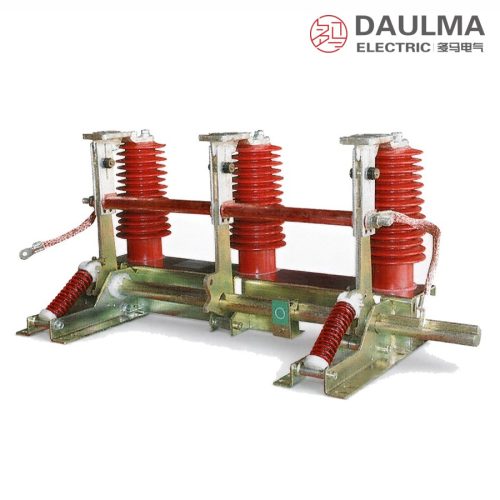
The JN15-24/31.5 is an indoor high voltage earthing switch for 24 kV, 50/60 Hz three-phase power systems, complying with GB 1985-2004 and IEC 62271-102. It provides short-circuit making capacity that protects the other electrical equipment inside the switchgear from damage, matches various types of indoor high voltage metal-enclosed switchgear, and serves as the protective earth for high voltage equipment during inspection and maintenance.
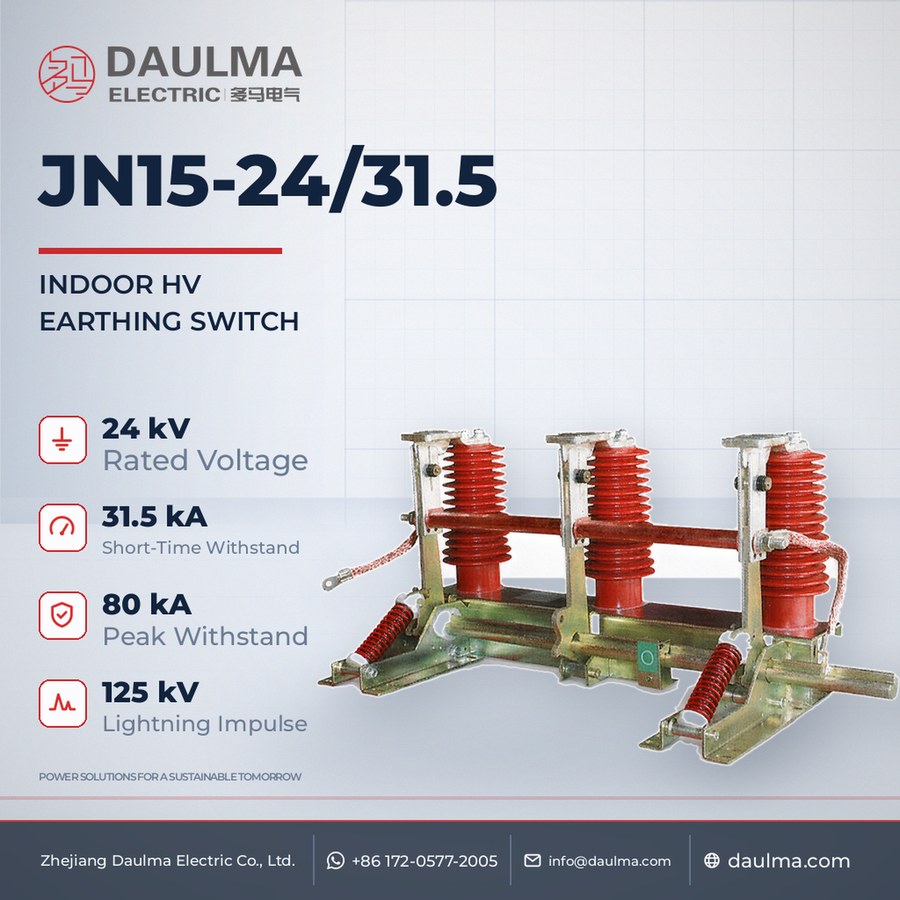
The switch is rated 31.5 kA rated short-time withstand current for 4 s, with 80 kA rated peak withstand and short-circuit making current, a 1-minute power-frequency withstand voltage of 65 kV, a lightning impulse withstand voltage of 125 kV, and a mechanical life of 2000 operations.
Model Designation
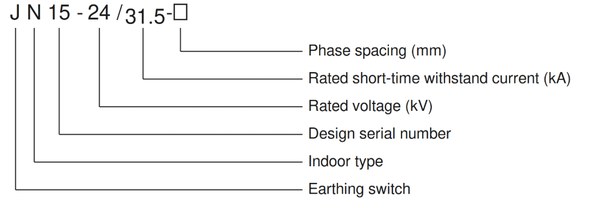
The type is designated J N 15 – 24 / 31.5 – □ and decoded as follows:
- J — earthing switch
- N — indoor device
- 15 — design number
- 24 — rated voltage in kV
- 31.5 — rated short-time withstand current in kA
- □ — phase spacing (between-pole distance) in mm
Construction and Operation
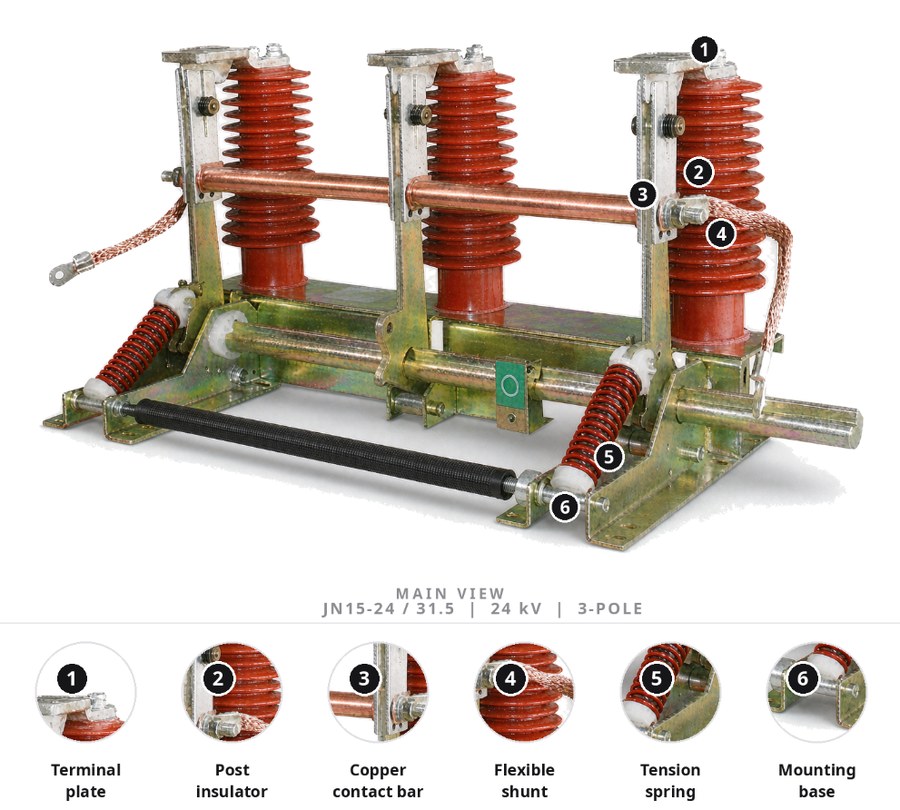
The JN15-24/31.5 uses resin-insulated support insulators whose live parts are made of silver-plated electrolytic copper (99.9%), with the earth blade connected directly to the drive shaft so that all three poles make or break the earth connection together. The contact system is designed with oversized dimensions to keep a high contact pressure between blade and fixed contact, reduce the contact resistance and minimise metal wear over the service life while withstanding the thermal and mechanical stresses of a short circuit. A quick-action spring mechanism makes the opening and closing speed independent of the operator, and the switch can be supplied with a manual spring-operated or motorised mechanism and interlocked with the associated circuit breaker so that it can be closed only when the main circuit is de-energised.
Technical Parameters
Service Conditions
- Altitude: not exceeding 1000 m
- Ambient air temperature: upper limit +40 ℃, lower limit −10 ℃
- Seismic intensity: not exceeding 8 degrees
- Free from flammable, explosive, severe dust, chemical corrosion, or violent vibration
Main Technical Parameters
| No. | Item | Unit | Data |
|---|---|---|---|
| 1 | Rated voltage | kV | 24 |
| 2 | Rated frequency | Hz | 50 / 60 |
| 3 | Rated short-time withstand current | kA | 31.5 |
| 4 | Rated short-circuit duration | s | 4 |
| 5 | Rated peak withstand current | kA | 80 |
| 6 | Rated short-circuit making current | kA | 80 |
| 7 | Rated power-frequency withstand voltage (1 min) | kV | 65 (relative to earth and between phases) |
| 8 | Rated lightning impulse withstand voltage | kV | 125 |
| 9 | Mechanical life | operations | 2000 |
Installation & Wiring
Installation
Installation, commissioning and maintenance must be carried out by qualified personnel, and the earthing switch must be handled only on de-energised circuits. Insert the retaining pin so that the switch cannot be closed while maintenance work is in progress.
Outline & Mounting Dimensions
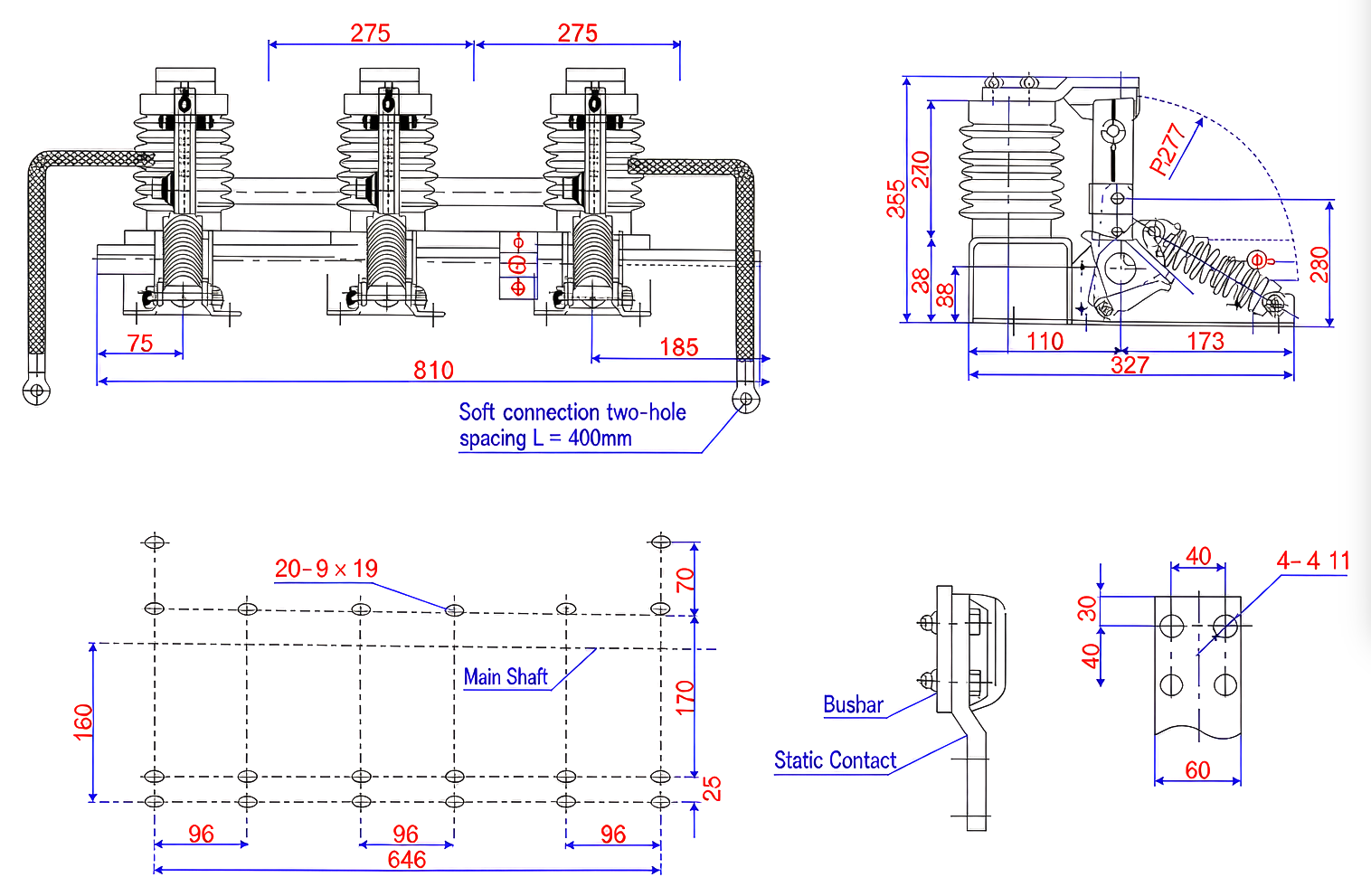
Dimensions are taken from the catalogue outline drawing and are for cubicle preparation only; confirm the certified dimensional drawing for the ordered phase spacing before installation.
Maintenance
- Inspect one to two times per year and immediately after a severe short-circuit event.
- Clean the conductive parts and insulator surfaces, wash the pivots with alcohol or a suitable cleaning solvent, and re-grease with industrial petroleum jelly.
- Check that all fastening bolts are tight and that the earthing connection is sound.
- Replace blades, contacts or pressure springs that are damaged or permanently deformed, then perform several opening and closing tests before returning to service.
Selection & FAQs
Selection Guide
Follow these steps to configure the correct JN15-24/31.5 earthing switch for your switchgear:
- Step 1 – Ratings: confirm the rated voltage (24 kV) and frequency (50/60 Hz) of the indoor distribution network.
- Step 2 – Thermal stability: verify the rated short-time withstand current (31.5 kA) against the prospective three-phase short-circuit current at the installation point.
- Step 3 – Dynamic stability: verify the rated peak withstand current (80 kA) against the maximum short-circuit impulse current.
- Step 4 – Duration: confirm the rated short-circuit duration (4 s) matches the back-up protection operating time.
- Step 5 – Phase spacing: select the between-pole distance to suit the busbar arrangement of the associated switchgear cubicle.
- Step 6 – Operating mechanism: choose a manual spring-operated or motorised mechanism; for motorised versions, match the control supply voltage (DC is preferred for reliability and safety).
- Step 7 – Interlock and indication: decide whether a voltage-presence (live) indicator and a mechanical or electromagnetic interlock with the circuit breaker are required.
- Step 8 – Lever position: confirm the operating-lever mounting position (left-hand or right-hand) when ordering.
Frequently Asked Questions
What is the difference between an earthing switch and a disconnector?
The disconnector provides a visible insulation gap to isolate a circuit without load, while the earthing switch bonds the de-energized circuit to earth to protect maintenance personnel and equipment. In many cabinets the two functions are combined and mechanically interlocked.
How is the rated short-time withstand current (31.5 kA) determined?
It must be equal to or greater than the prospective three-phase short-circuit current at the installation point for the declared duration (4 s). This is the thermal-stability criterion for selecting the earthing switch.
Can the JN15-24/31.5 be operated manually and electrically?
Yes. It is available with a simple manual spring-charged operating mechanism or, on request, with a motorized mechanism for remote or interlocked control.
Does it have short-circuit making capacity?
Yes. The switch has a rated short-circuit making current of 80 kA (peak), allowing it to close onto a faulted circuit and safely earth it, protecting other equipment inside the switchgear.
What is the mechanical life?
The earthing switch is rated for 2000 mechanical operating cycles. Thanks to the quick-action spring mechanism, the closing and opening speed is independent of the operator’s speed.
Can a live indication device be added?
Yes. On request the switch can be equipped with a sensor and a voltage-presence indicator, and can be fitted with an interlock to prevent energizing an earthed circuit.
With which switchgear can it be used?
It can be paired with various types of indoor high-voltage metal-enclosed switchgear used in 24 kV systems, serving as the maintenance earthing device.