Overview
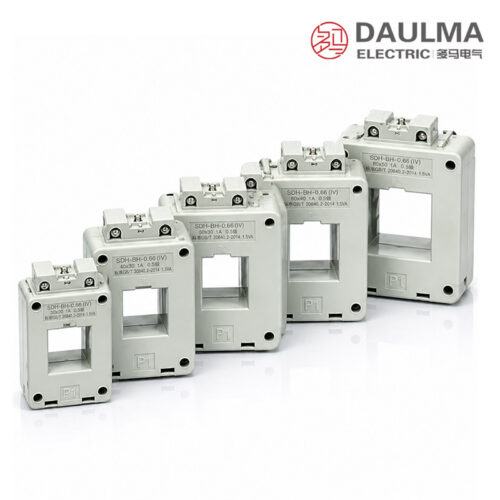
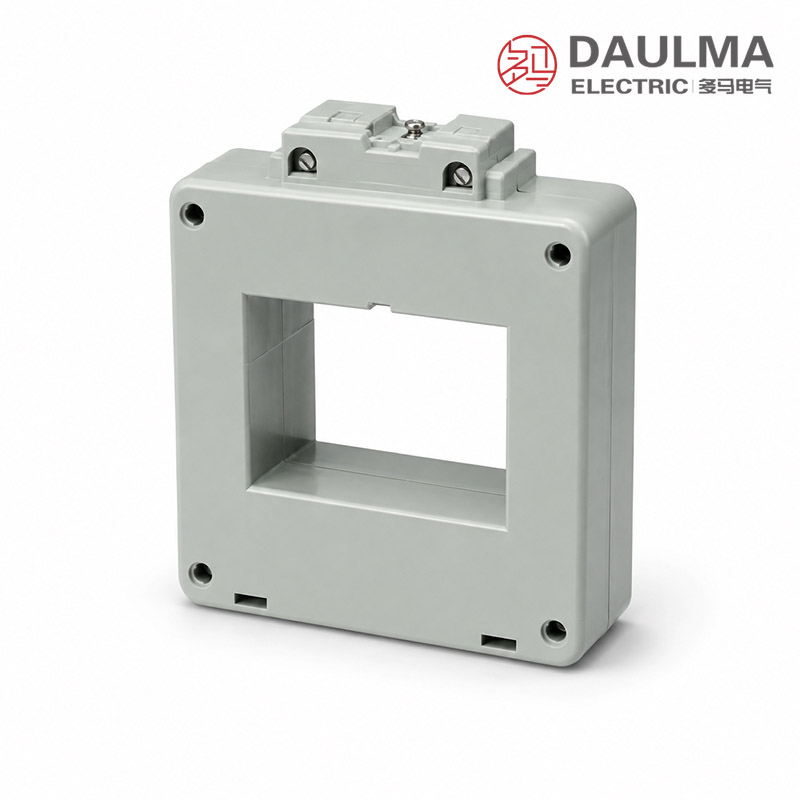
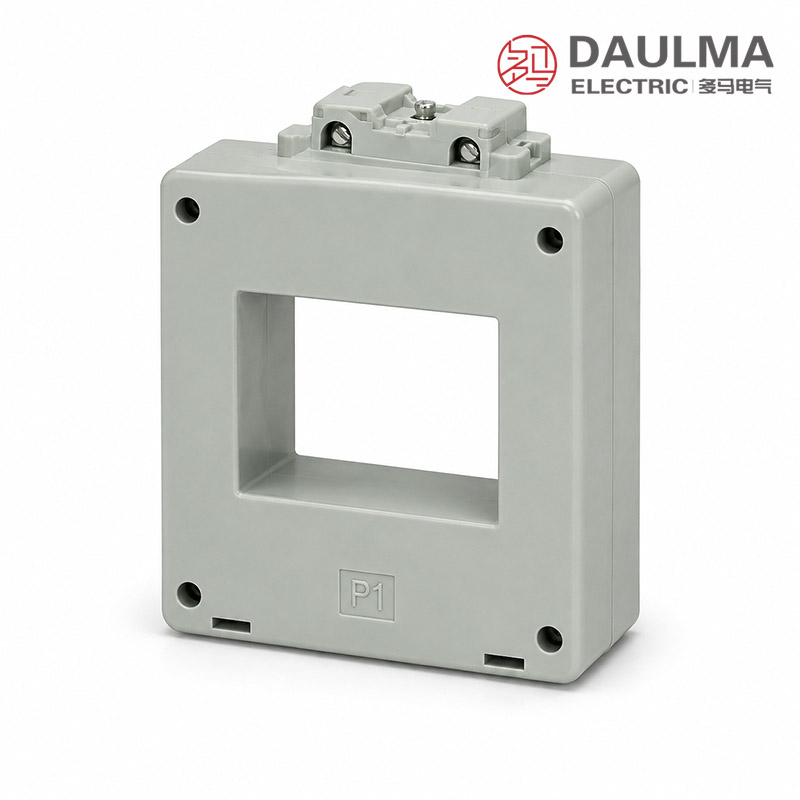
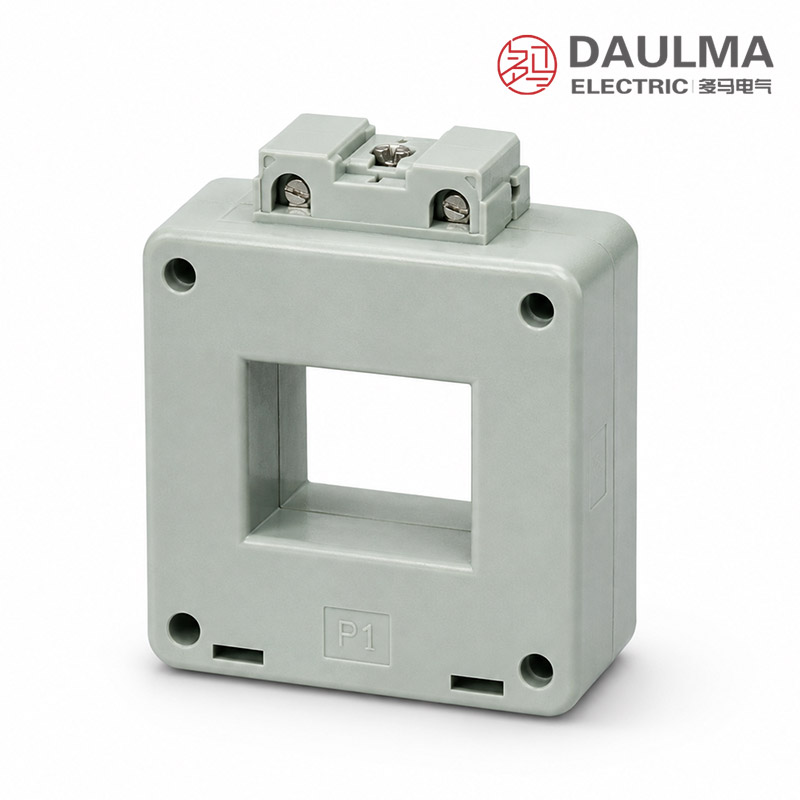
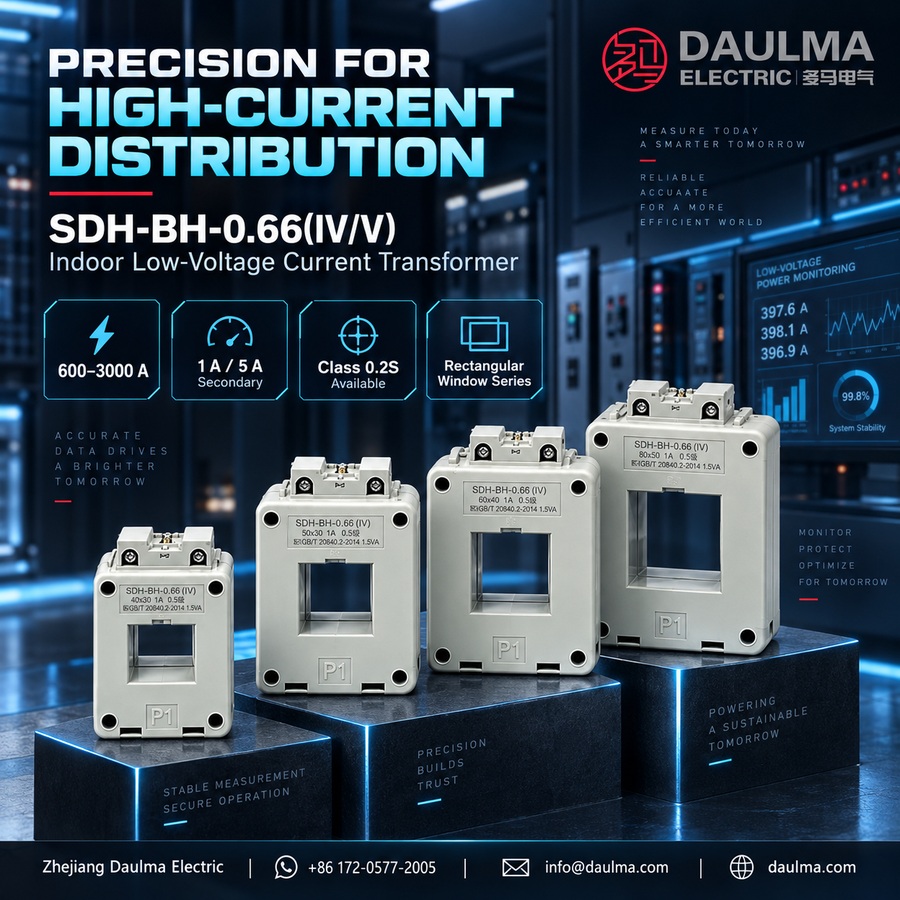
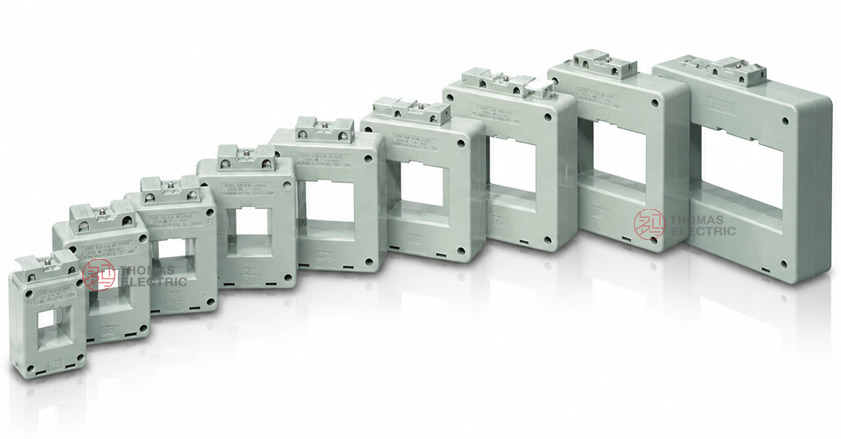
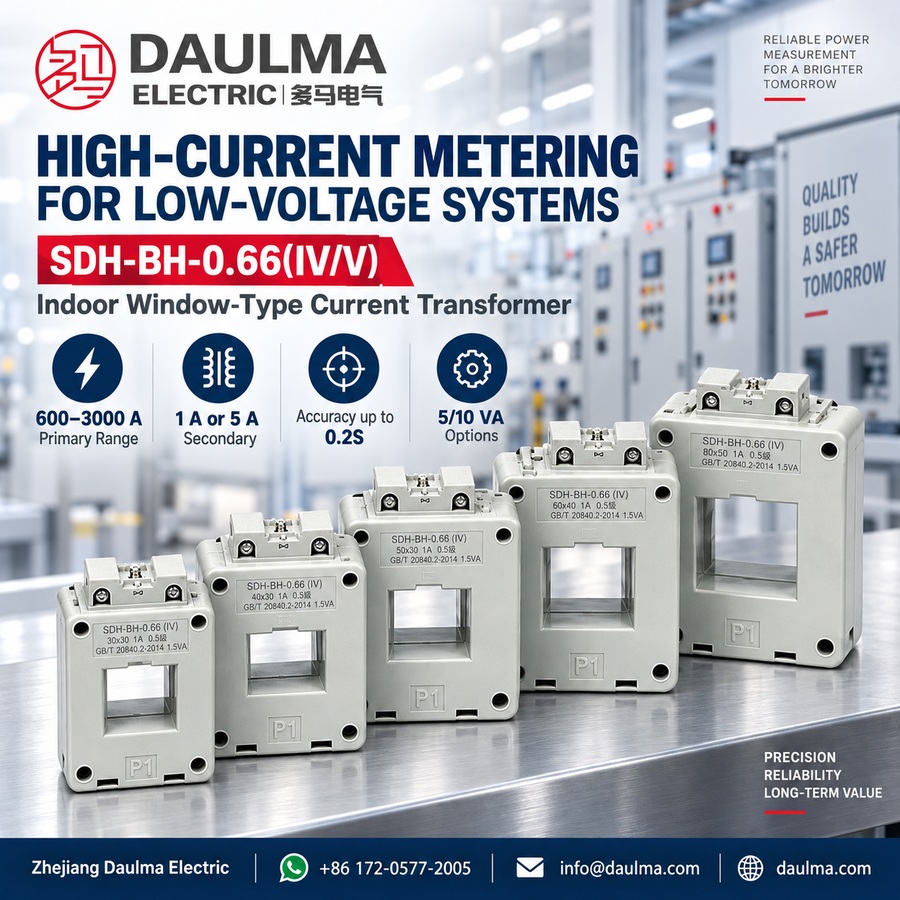
The SDH-BH-0.66(IV/V) series are low-voltage indoor current transformers designed for accurate current measurement and energy metering in 0.66 kV AC power systems. Built with a window-type (rectangular aperture) configuration, these cast-resin insulated devices enable safe, galvanically isolated secondary current output proportional to the primary conductor—typically a busbar or cable passing through the core. They are engineered for reliable operation in indoor switchgear cabinets, distribution panels, and commercial/industrial metering installations.
Utilizing electromagnetic induction per Faraday’s law, the toroidal magnetic core ensures high accuracy under standard burdens. With rated secondary currents of 1 A or 5 A and metering accuracy classes up to 0.2s, these CTs support precise energy monitoring and load management. Their compact, fully enclosed plastic housing provides robust insulation, moisture resistance, and mechanical stability suitable for long-term indoor service in low-voltage environments.
Key Ratings Snapshot
| Parameter | Rating |
|---|---|
| System voltage class | 0.66 kV (660 V) |
| Rated frequency | 50 Hz |
| Rated secondary current | 1 A or 5 A |
| Accuracy classes (metering) | 0.2, 0.2s, 0.5, 0.5s |
| Rated burden | 5 VA or 10 VA |
| Burden power factor | cosφ = 0.8 (lagging) |
| Window aperture sizes | Series IV: 60×30 to 120×50 mm Series V: 60×30 to 130×50 mm |
| Insulation level | Per GB1208-2006 and IEC60044-1:2003 |
Model Designation
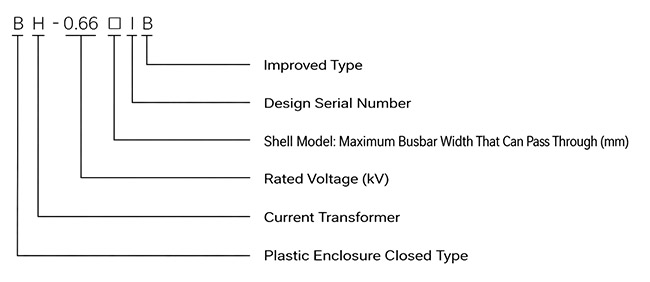
- BH — Indoor plastic case series
- 0.66 — Voltage class: 0.66 kV (660 V)
- (IV) or (V) — Mechanical design variant
- Window dimensions — Rectangular aperture size in mm (e.g., 60×30, 80×30, etc.)
Construction
The SDH-BH-0.66(IV/V) features an indoor plastic case with a fully enclosed, window-type (rectangular aperture) structure. The insulation system is molded plastic, providing reliable dielectric strength and environmental protection for 660 V applications. Internally, it employs a ring-type magnetic core around which secondary windings are precisely wound. Primary current flows through a busbar or cable passing through the central window, eliminating direct electrical contact. Secondary terminals are clearly marked (typically S1/S2 or K/L) following standard polarity conventions to ensure correct metering connections. This construction delivers durability, moisture resistance, and long-term performance in indoor low-voltage distribution environments.
Technical Parameters
Service Conditions
- Installation environment: Indoor installation only (enclosed distribution cabinets or switchgear)
- Altitude: Not exceeding 1000 m above sea level (higher altitude requires engineering confirmation)
- Ambient temperature: −5 °C to +40 °C
- Relative humidity: Daily average ≤ 95%, monthly average ≤ 90%
- Environmental conditions: Free from corrosive gases, explosive atmospheres, severe vibration, or mechanical shock
Technical Parameters
This section provides selection-oriented technical data for the BH-0.66 (IV/V) series indoor, plastic case current transformer used in 0.66 kV (660 V) class AC systems (50 Hz). Data shown below is intended for preliminary selection of accuracy class combinations, rated burdens, and window aperture dimensions.
Data Reference — BH-0.66(IV) BH0.66(V) Series
| Rated Primary Current (A) |
Rated Secondary Current (A) |
Accuracy Class |
Rated Output (VA) |
|---|---|---|---|
| 600, 800, 1000, 1500 | 5 | 0.2 | 5 |
| 5, 1 | 0.2s | — | |
| 2000, 3000 | 1 | 0.5 | — |
| — | 0.5s | 10 |
Installation & Wiring
Outline Dimensions
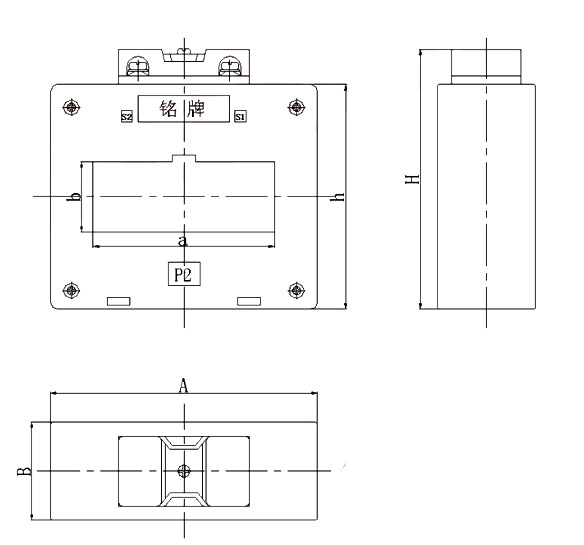
Dimensions a and b indicate the internal window aperture size, which must accommodate the primary conductor (busbar or cable) with sufficient clearance. Overall external dimensions are denoted by A, B (or B1/B2 for V-series), and H. Ensure adequate space is provided around the transformer for mounting, secondary terminal access, and ventilation during installation.
Wiring Diagram
The secondary terminals must be connected to the measuring instrument or protective relay using appropriate wiring. Always ensure the secondary circuit is never left open when the current transformer is energized. One point of the secondary winding should be reliably grounded in accordance with applicable electrical standards.
Selection & FAQs
Selection Guide
- Select the 600A–3000A ratio from the maximum busbar current and required metering range.
- Choose Series IV or V by busbar width, thickness, aperture clearance, and available cabinet space.
- Specify a 1A or 5A secondary, required metering class, and 5VA or 10VA rated output.
- Calculate the total meter and cable burden and keep it within the selected model’s VA rating.
- Confirm mounting orientation, busbar alignment, terminal access, polarity, grounding, and indoor conditions.
Frequently Asked Questions
Q1: Can this low-voltage current transformer be installed outdoors?
No, this model is strictly for indoor installation. It must be housed in enclosed distribution cabinets or switchgear. Contact us for outdoor-rated alternatives.
Q2: Which accuracy class is suitable for energy metering?
The 0.2S or 0.2 accuracy class is recommended for precision metering. These classes support rated primary currents up to 1500A with a 5A or 1A secondary output. Specify your exact metering requirements during ordering.
Q3: What is the maximum rated primary current available?
The maximum rated primary current for this series is 3000A. This configuration typically pairs with a 1A secondary current and 0.5 or 0.5s accuracy class. Confirm specific burden requirements with our engineering team.
Q4: Can we use this transformer at altitudes above 1000m?
Standard models are rated for altitudes not exceeding 1000m. For higher elevations, derating or special design modifications are required. Please provide your exact site altitude for factory confirmation.
Q5: What factory tests are performed before shipment?
Standard routine tests include ratio, polarity, and insulation resistance checks. Specific type tests or third-party certifications depend on your project specifications. Contact our sales team for detailed test reports.
Q6: What AC systems is this plastic case CT designed for?
It is designed for 0.66 kV (660 V) class AC systems operating at 50 Hz. This indoor current transformer is ideal for relay protection and measurement in low-voltage switchgear.
Q7: What are the humidity limits for the installation environment?
The ambient relative humidity must not exceed a daily average of 95% or a monthly average of 90%. Ensure the switchgear environment is free from corrosive gases and severe vibration.