Overview
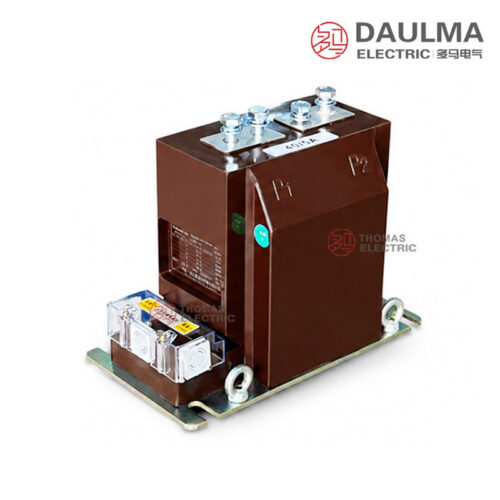
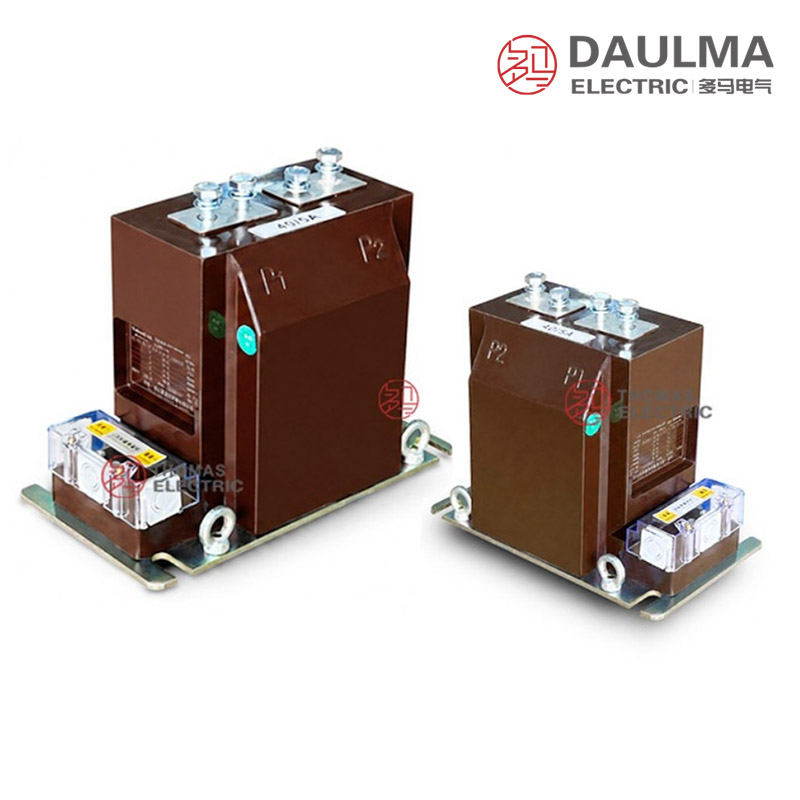
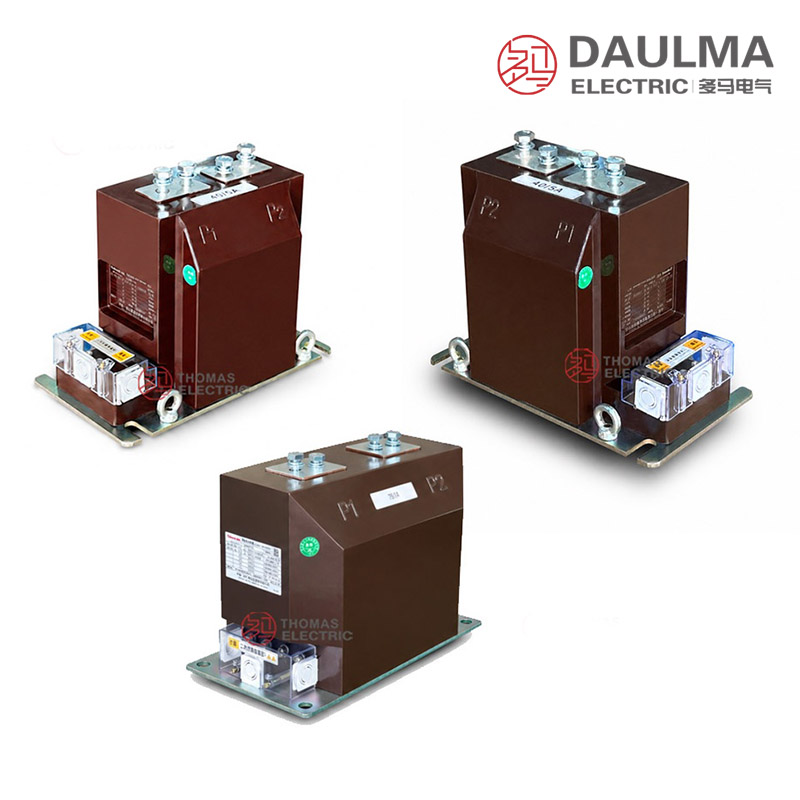
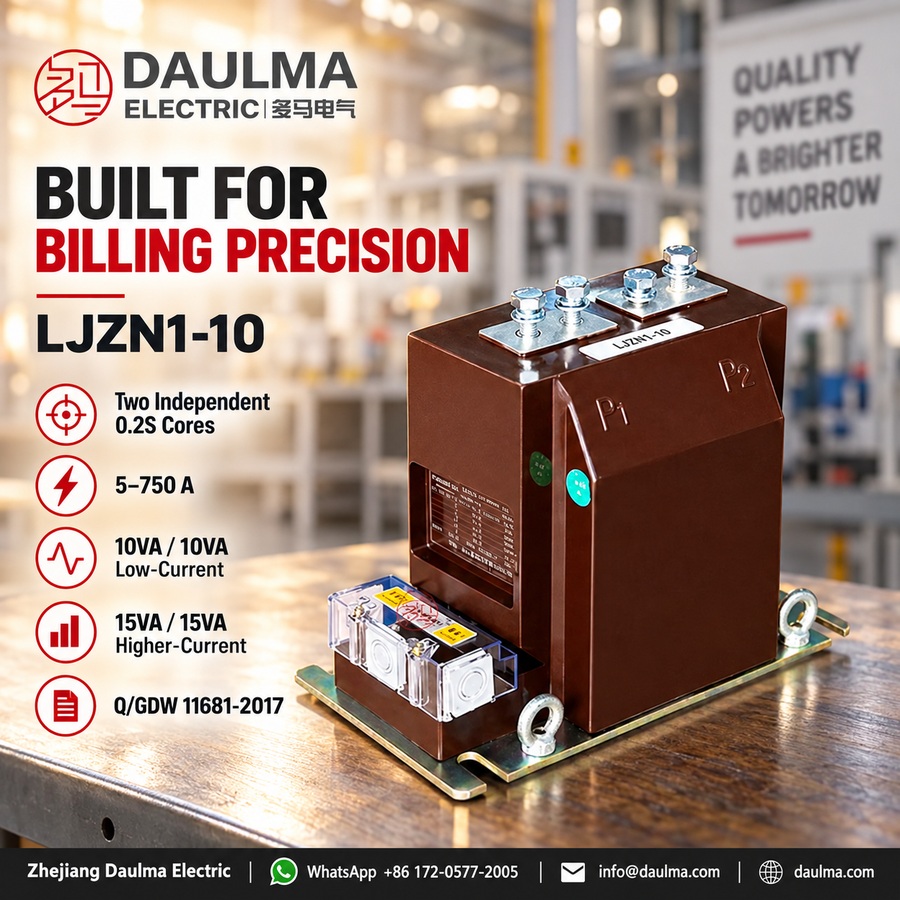
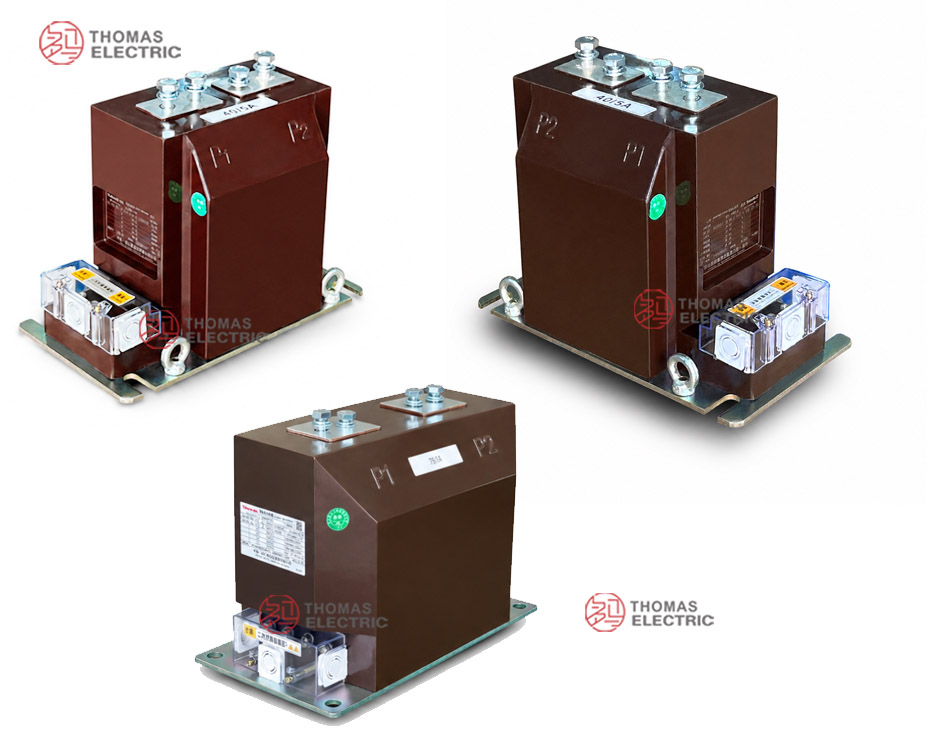
The LJZN1-10 is an indoor epoxy cast-resin metering current transformer designed for use in 10 kV, 11 kV and 12 kV class medium-voltage power systems. It features a fully enclosed support-type structure with epoxy resin insulation, ensuring stable dielectric performance and mechanical robustness in indoor environments.
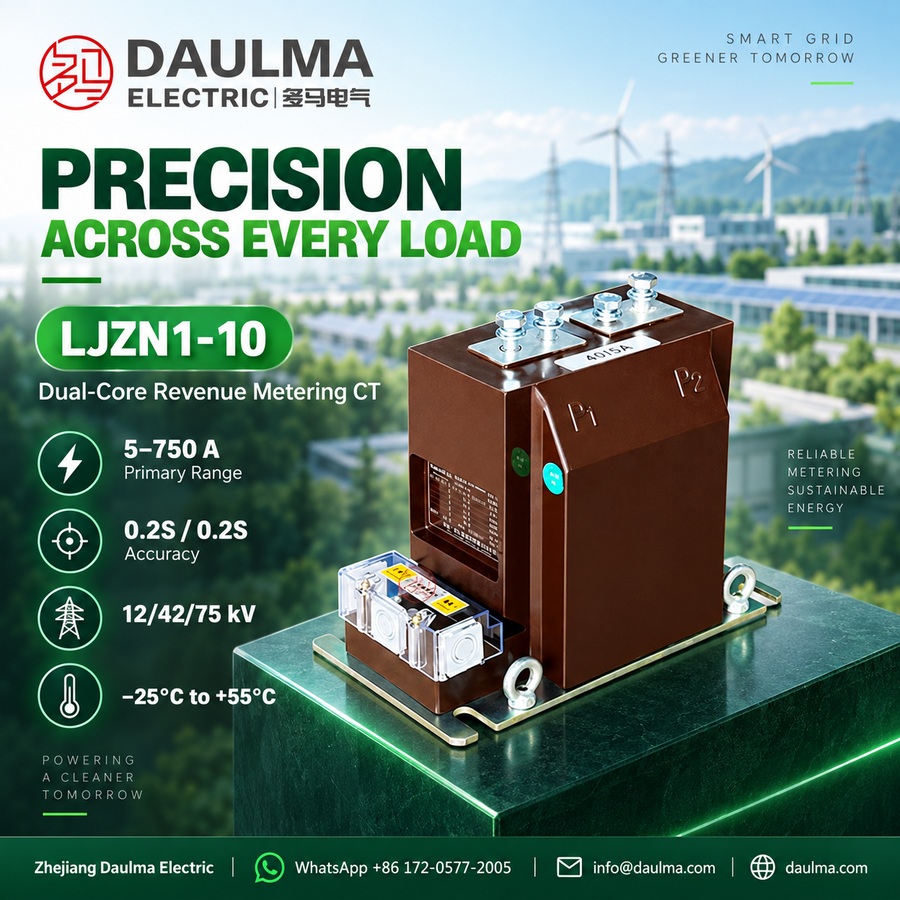
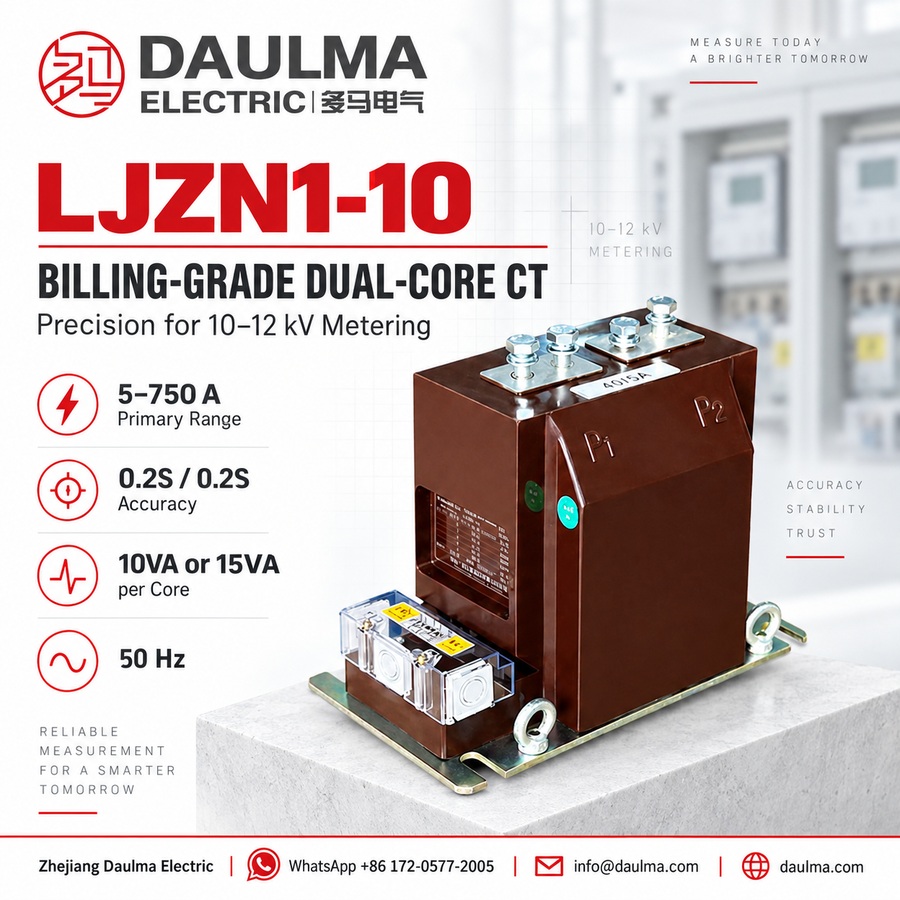
Compliant with Q/GDW 11681-2017 and tailored to State Grid metering requirements, the unit offers a standard accuracy combination of 0.2S / 0.2S and supports secondary currents of 5 A or 1 A. It is ideal for integration into power metering cabinets, State Grid-style measurement panels, and indoor switchgear where high-precision current input is essential for billing-grade energy metering.
Key Ratings Snapshot
| Parameter | Rating |
|---|---|
| System voltage application | 10 kV, 11 kV, 12 kV |
| Rated insulation level | 12/42/75 kV |
| Rated frequency | 50 Hz |
| Rated secondary current | 5 A or 1 A |
| Accuracy combination | 0.2S / 0.2S |
| Ambient temperature range | -25°C to +55°C |
| Insulation type | Epoxy cast-resin |
| Application type | Metering (State Grid) |
| Structure | Indoor, fully enclosed support-type |
| Primary function | Energy metering |
| Standard compliance | Q/GDW 11681-2017 |
| Secondary circuit requirement | Must remain closed during operation |
Model Designation
- L: Current transformer
- J: Metering / measurement application series
- Z: Epoxy resin casting insulation
- N: Indoor type / special metering structure code
- 1: Design serial number
- 10: 10 kV catalogue voltage class; suitable for 10 kV, 11 kV and 12 kV class systems when insulation coordination is confirmed
Construction
The LJZN1-10 employs an indoor, fully enclosed epoxy cast-resin insulation structure. The primary conductor, secondary winding, and magnetic core are completely encapsulated within the solid resin body. This construction provides excellent dielectric stability, enhanced moisture resistance, and superior mechanical protection—critical for reliable long-term operation in indoor switchgear and metering environments. Unlike general-purpose protection current transformers, this design prioritizes metrological performance, ensuring minimal ratio error and phase displacement under specified burden conditions to meet stringent billing-grade accuracy requirements.
Technical Parameters
Service Conditions
- Installation location: indoor medium-voltage switchgear or metering cabinet
- System voltage: 10 kV, 11 kV and 12 kV class networks
- Rated frequency: 50 Hz
- Ambient temperature: -25°C to +55°C
- Installation environment: should be free from severe vibration, conductive dust, corrosive gas, explosive medium, heavy pollution and abnormal condensation.
- Metering wiring: should be short, secure and matched with the rated output burden to maintain accuracy.
Technical Parameters
The LJZN1-10 is an epoxy cast-resin current transformer designed for State Grid metering applications in 10–12 kV class systems. It operates within an ambient temperature range of -25°C to +55°C and complies with Q/GDW 11681-2017. The device supports primary current ratings from 5 A up to 750 A, with secondary outputs of 1 A or 5 A, and features high-accuracy 0.2S/0.2S class combinations.
| Rated primary current (A) |
Accuracy classed combination |
Rated Output (VA) |
Short-time thermal current |
Rated dynamic current (kA) |
|
|---|---|---|---|---|---|
| 0.2S | 0.2S | ||||
| 5, 10, 15 | 0.2S/0.2S | 10 | 10 | 4kA/1s | 10 |
| 20, 25 | 15 | 15 | 5kA/2s | 12.5 | |
| 30, 40 | 8kA/2s | 20 | |||
| 50, 60 | 10kA/2s | 25 | |||
| 75, 80 | 16kA/2s | 40 | |||
| 100, 150, 200, 250 | 20kA/2s | 50 | |||
| 300, 400, 500 | 25kA/4s | 63 | |||
| 600, 750 | 31.5kA/4s | 80 | |||
Installation & Wiring
Installation Diagram
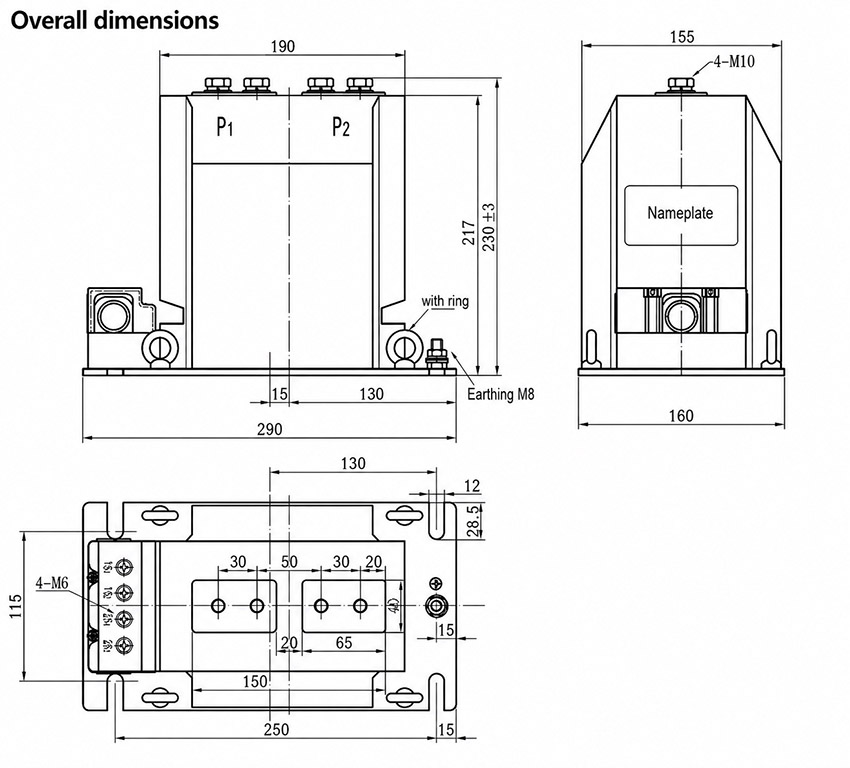
The LJZN1-10 is installed as an indoor support-type current transformer with the primary terminals (P1/P2) positioned at the top and the secondary terminal block located at the lower section of the unit. Mounting is achieved through a fixed base with pre-defined hole positions as specified in the approved outline drawing. Ensure alignment with the metering cabinet structure and verify clearances before final fixation.
Selection & FAQs
Selection Guide
- Confirm the utility metering specification, 12/42/75kV insulation level and Q/GDW 11681-2017 requirement where applicable.
- Select a 5A–750A ratio that keeps normal operating current within the required 0.2S metering range while allowing expected load growth.
- Choose a 1A or 5A secondary and define the independent purpose, test links, terminal assignment and one-point ground for both 0.2S cores.
- Verify 10VA/10VA for 5A–15A ratios or 15VA/15VA for higher ratios against meter and secondary-cable burden.
- Check ratio-specific thermal/dynamic duty, P1/P2 direction, terminal sealing, mounting drawing, clearances and −25°C to +55°C environment.
Frequently Asked Questions
Q1: Can the LJZN1-10 CT operate on 11kV and 12kV networks?
Yes. It supports 10kV, 11kV, and 12kV indoor medium-voltage networks. The device operates at a rated frequency of 50 Hz.
Q2: Which accuracy class is required for State Grid revenue metering?
The 0.2S/0.2S accuracy class combination is specified for this application. It ensures high precision for billing across varying load conditions. Contact us to verify specific secondary output requirements.
Q3: What type of manufacturer produces these indoor medium-voltage current transformers?
We are a specialized manufacturer of epoxy cast-resin instrument transformers. The LJZN1-10 is built specifically for indoor medium-voltage switchgear and metering cabinets.
Q4: How do I select the primary current rating for short-circuit withstand?
Primary ratings range from 5 A to 750 A. You must match the short-time thermal and rated dynamic current parameters to your specific network fault levels. Request the full datasheet for detailed short-circuit ratings.
Q5: Are these current transformers certified for State Grid metering applications?
Yes, the LJZN1-10 fully complies with the Q/GDW 11681-2017 standard. It is specifically engineered for State Grid metering applications.
Q6: What factory tests are performed before shipment?
Standard routine tests are conducted per applicable technical standards. Specific type tests or extended aging tests are subject to confirmation. Contact our quality assurance team for the detailed test report.
Q7: Why must the installation environment be free from conductive dust?
Conductive dust and corrosive gases can compromise the epoxy resin insulation. The device requires a clean indoor environment with ambient temperatures between -25°C and +55°C. Verify your site conditions match these parameters.