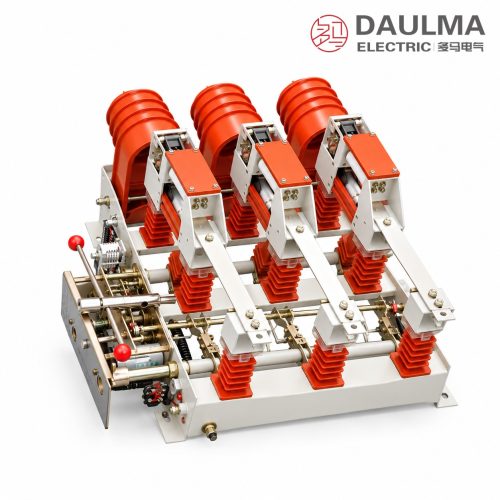
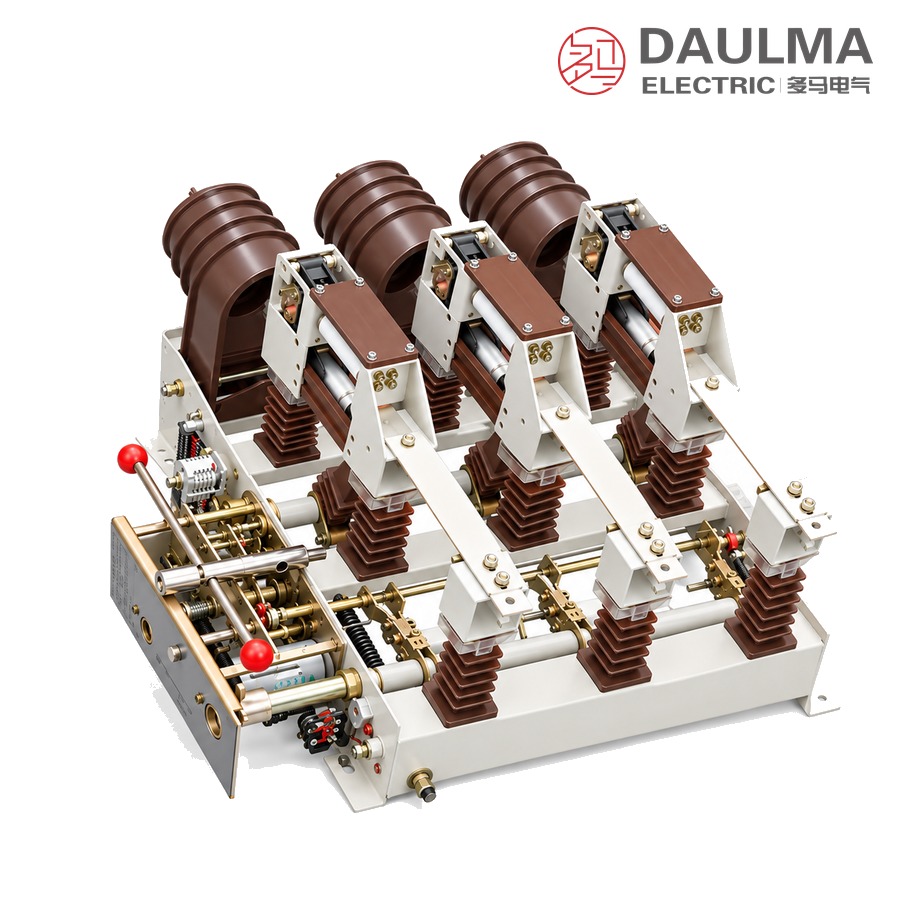
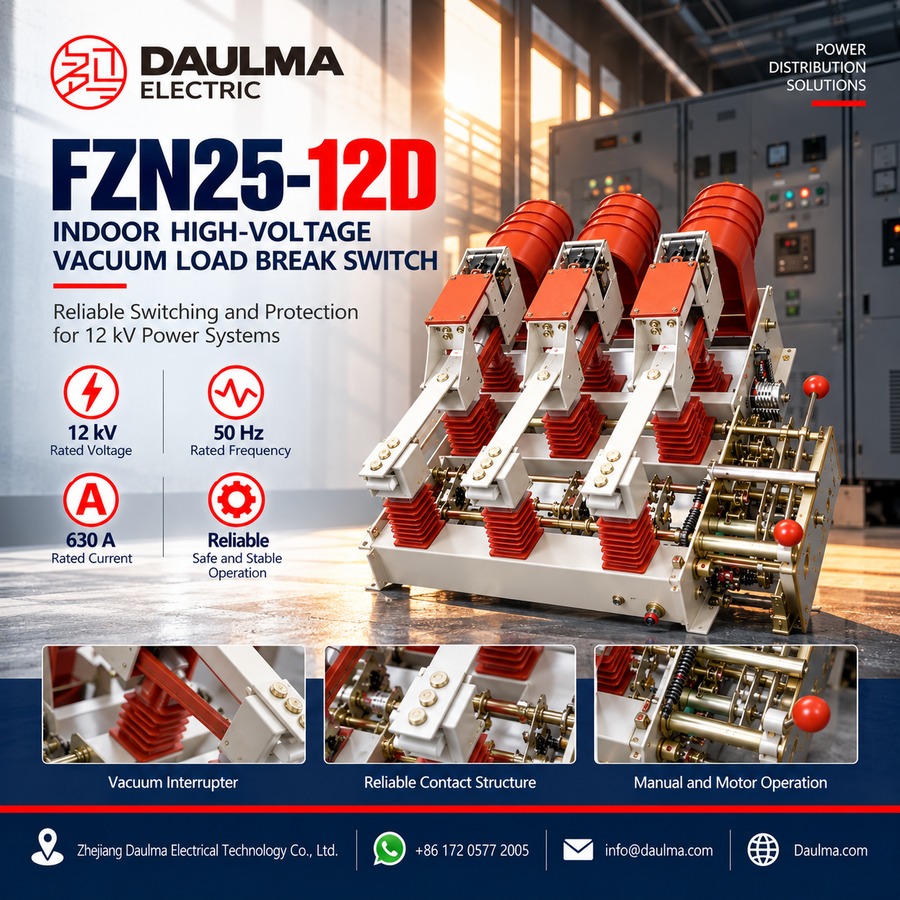
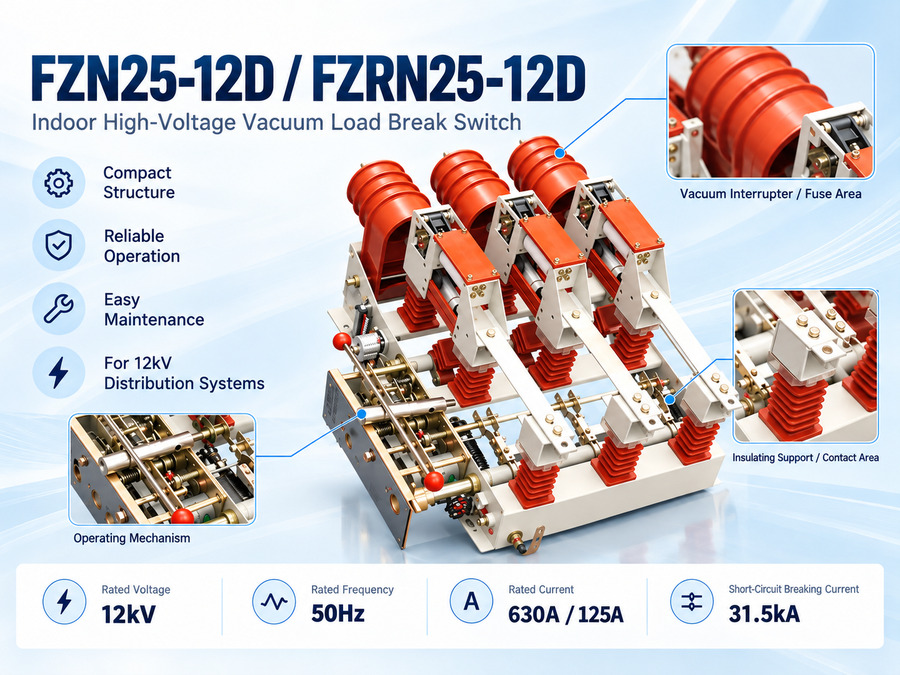
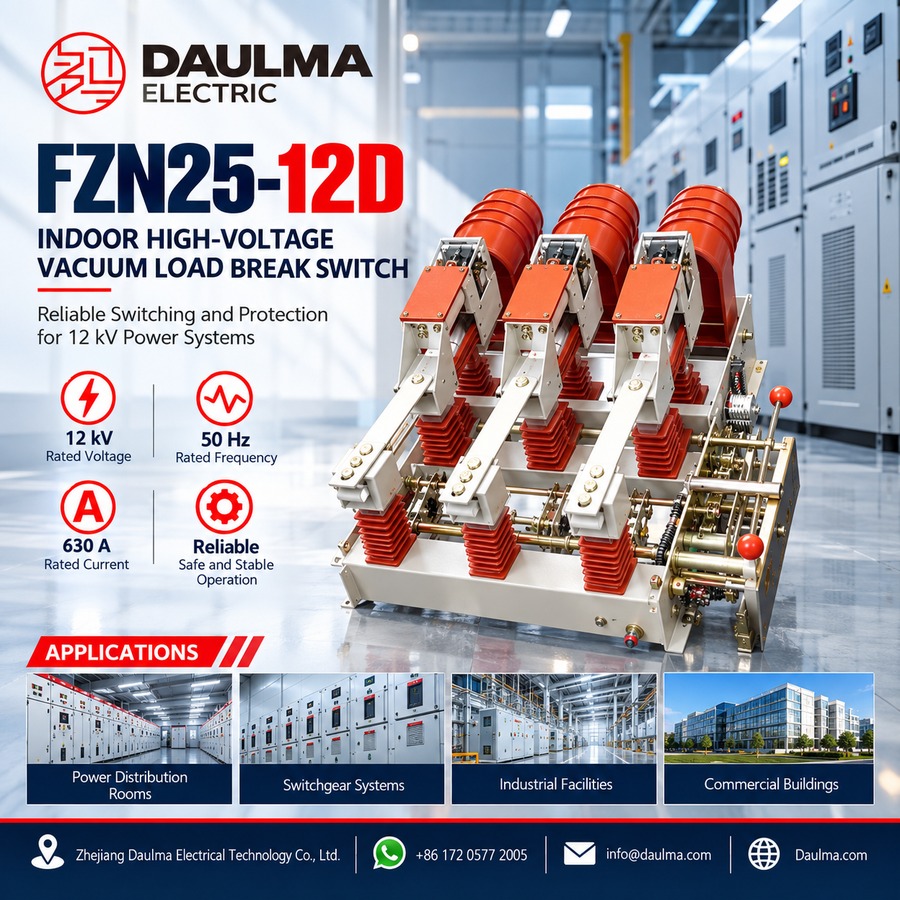
The FZN25-12D indoor high-voltage vacuum load break switch and the FZRN25-12D switch-fuse combination unit work in three-phase AC 50 Hz ring supply and terminal supply networks and on industrial power equipment, where the switch controls the load and the combination unit provides short-circuit protection. The switch makes and breaks load and closed-loop current at 630 A, cable charging current at 10 A and no-load transformers up to 1250 kVA, and the combination unit clears any current up to its rated short-circuit breaking current of 31.5 kA.
A direct-acting drive links the isolating gap to the vacuum arc chamber, so the chamber carries high voltage only during the instant of closing and opening and the unit stays small and light, and one operation works both gaps. Manual and electric operation are both provided, and earthing flaps interlocked with the earthing switch sit between the static contacts and the conducting cylinders, which keeps maintenance safe and short.
Model Designation
Two designations are used, one for the switch and one for the combination unit, and the drawing below is the official one for this series:
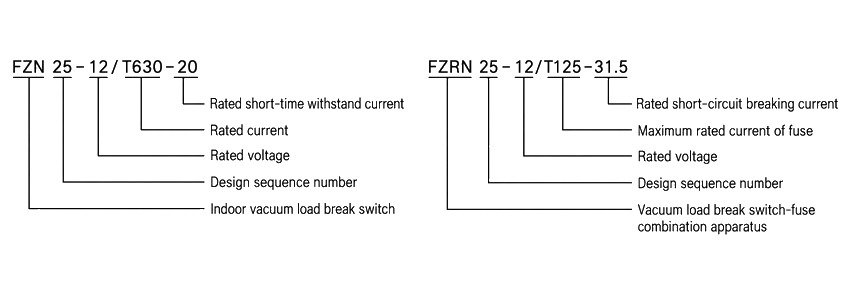
Load break switch — FZN25-12D/T 630-20
- FZN: indoor vacuum load break switch
- 25: design sequence number
- 12: rated voltage, kV
- D: with earthing switch
- T: with spring operating mechanism
- 630: rated current, A
- 20: rated short-time withstand current, kA
Switch-fuse combination unit — FZRN25-12D/T 125-31.5
- FZRN: vacuum load break switch-fuse combination apparatus
- R: combined with fuse
- 125: maximum rated current of the fuse, A
- 31.5: rated short-circuit breaking current, kA
The remaining characters carry the same meaning as in the switch designation. The fuse itself is an SDLAJ-12, and its SFLAJ-12 striker is what releases the mechanism after a fuse blows.
Construction and Operation
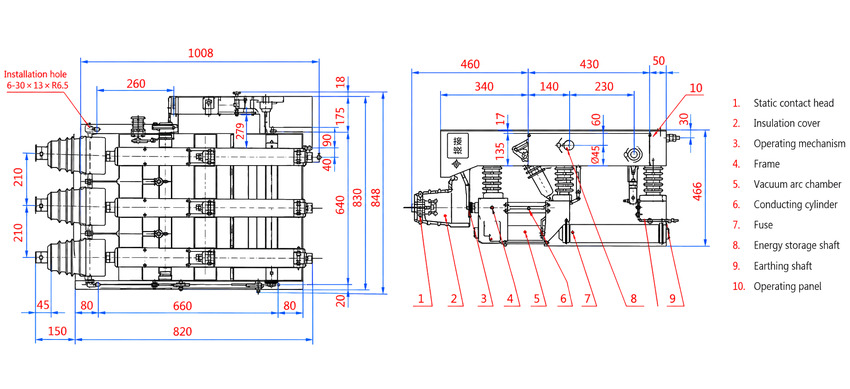
The three poles stand on a common frame. Each pole has a static contact head at the rear, a vacuum arc chamber and a conducting cylinder carrying the moving contact, an insulation cover over the live part and red porcelain insulators to the frame. The operating mechanism at the front of the frame drives the poles through the energy storage shaft and the earthing shaft, and the operating panel on the front shows and selects the position.
The isolating gap and the vacuum chamber move together in one operation, so a single stroke gives the breaking duty and the visible isolation. The earthing switch works against the static earthing contact, and the earthing flaps between the static contacts and the conducting cylinders are interlocked with it, so the de-energised side is earthed before anyone works on it and the fuse compartment cannot be opened live.
Mechanism and Control
Closing energy comes from a charged spring on the energy storage shaft, so the contact speed is set by the mechanism and not by the operator, and the switch can be worked as often as the network asks — the mechanical life is 1000 operations. Energy can be stored by hand or from the control supply, which is what makes electric operation and remote signalling possible; the auxiliary circuits are rated at AC or DC 220 V or 110 V.
In the combination unit the release device is worked by the striker of the blown SDLAJ-12 fuse, which needs only 2 to 5 J of striker output energy. That is how a fault on the protected feeder is cleared by the fuse and reported to the mechanism, so the switch never opens short-circuit current on its own and the feeder is never left on two phases.
Technical Parameters
Service Conditions
- Ambient temperature: +40℃ upper, -25℃ lower
- Altitude: Not more than 1000 m
- Relative humidity: Daily average not more than 95%, monthly average not more than 90%
- Seismic intensity: Not more than 8 degrees
- Site condition: No fire, explosion hazard, chemical corrosion or violent vibration
- Pollution level: II
Technical Data
| No. | Item | Unit | FZN25-12D/
T 630-20 (load break switch) |
FZRN25-12D
/T 125-31.5 (switch-fuse combination unit) |
|---|---|---|---|---|
| 1 | Rated voltage | kV | 12 | |
| 2 | Rated frequency | Hz | 50 | |
| 3 | Rated current | A | 630 | 125 |
| 4 | 1 min power-frequency withstand voltage | kV | Vacuum arc chamber gap 30; phase-to-earth and phase-to-phase 42; isolating gap 48 | |
| 4 | Lightning impulse withstand voltage | kV | Phase-to-earth and phase-to-phase 75; isolating gap 85 | |
| 5 | Rated peak withstand current | kA | 50 | — |
| 6 | Rated short-time withstand current, 4 s | kA | 20 | — |
| 7 | Rated active load breaking current | A | 630 | 125 |
| 8 | Rated closed-loop breaking current | A | 630 | 125 |
| 9 | Rated cable charging breaking current | A | 10 | 10 |
| 10 | No-load transformer breaking capacity | kVA | 1250 | 1250 |
| 11 | Rated short-circuit breaking current | kA | — | 31.5 |
| 12 | Rated transfer current and rated change-over current | A | — | 2000 |
| 13 | Fuse type | — | — | SDLAJ-12 |
| 14 | Striker output energy | J | — | 2–5 |
| 15 | Rated short-circuit making current | kA | 50 | |
| 16 | Earthing switch rated peak withstand current | kA | 50 | |
| 17 | Earthing switch rated short-time withstand current, 2 s | kA | 20 | |
| 18 | Auxiliary circuit rated voltage | V | AC/DC 220 V, 110 V | |
| 19 | Mechanical life | operations | 1000 | |
Installation & Wiring
Installation and Commissioning
The unit is bolted to the cubicle frame through the six 30 by 13 mm mounting holes, the closed, open and earthed positions and the interlocks between the switch, the earthing switch and the fuse compartment are checked on all three poles, the specified SDLAJ-12 fuse is fitted with its striker engaging the release device, and the main circuit resistance and the contact travel are measured before energisation.
Component Reference
The item numbers below follow the outline and installation drawing of the series:
- Static contact head
- Insulation cover
- Operating mechanism
- Frame
- Vacuum arc chamber
- Conducting cylinder
- Fuse
- Energy storage shaft
- Earthing shaft
- Operating panel
Applications
- Ring supply feeders of three-phase AC 50 Hz networks
- Terminal supply feeders to transformers and distribution boards
- Industrial power supply equipment
- Indoor switchgear and box-type substation cubicles on 12 kV networks
Selection & FAQs
Selection Guide
- Choose the switch or the combination unit. The FZN25-12D/T 630-20 carries and breaks load and closed-loop current at 630 A and relies on upstream protection for faults; a transformer or cable feeder that must also clear short-circuit current takes the FZRN25-12D/T 125-31.5 unit, where the fuse breaks the fault at 31.5 kA and the striker releases the mechanism so the feeder is never left on two phases.
- Check the fuse against the feeder. The combination unit is drawn at a maximum fuse rating of 125 A of the SDLAJ-12 type, so compare the full-load current and the transformer inrush with that rating, and confirm the 2000 A rated transfer current and change-over current against the incoming switchgear before ordering.
- Confirm the short-time duty. 20 kA for 4 s as the rated short-time withstand current and 50 kA as the rated peak withstand current set the busbar and the upstream coordination; the earthing switch is rated at the same 50 kA peak and 20 kA for 2 s, and the main circuit and the making duty carry 50 kA.
- Decide between this FZN25-12D and the FZN25-12DG. Both are 12 kV indoor vacuum units of the same design sequence. This one is the 630 A frame with 20 kA for 4 s, a 31.5 kA combination unit on a 125 A fuse and a mechanical life of 1000 operations. The FZN25-12DG is the larger frame, rated at 1250 A with 25 kA short-time withstand and a 200 A fuse, with a 125 A fuse available for lower feeders. Pick by current and fault duty, not by the model number alone, and never substitute one for the other across those ratings.
- Match the cubicle and the control supply. The frame occupies 1008 mm across, 848 mm high and 466 mm deep and is bolted through six 30 by 13 mm holes. The unit is for indoor use at pollution level II, not more than 1000 m above sea level, between -25 and +40 degrees, with a daily relative humidity average not above 95% and a monthly one not above 90%, in ground of seismic intensity 8 degrees or less and free from fire, explosion hazard, chemical corrosion and violent vibration. Electric operation needs an auxiliary supply of AC or DC 220 V or 110 V.
FAQs
Q1: What is the FZN25-12D used for?
It is an indoor three-phase vacuum load break switch for 50 Hz ring supply and terminal supply networks and for industrial power equipment, used to control the load and to isolate the circuit. The switch makes and breaks load and closed-loop current at 630 A, cable charging current at 10 A and no-load transformers up to 1250 kVA. The FZRN25-12D combination unit adds an SDLAJ-12 fuse so the same frame also clears short-circuit current up to 31.5 kA and gives the feeder protection.
Q2: How do I read FZRN25-12D/T 125-31.5?
FZN names the indoor vacuum load break switch and the added R that it is combined with a fuse, 25 is the design sequence number, 12 is the rated voltage in kV, D marks the earthing switch and T the spring operating mechanism. The trailing numbers give the current: 125 is the maximum rated current of the fuse in amperes and 31.5 is the rated short-circuit breaking current in kA. Read as FZN25-12D/T 630-20, without the R, the same designation describes the switch alone at 630 A with a rated short-time withstand current of 20 kA.
Q3: What is the difference between the FZN25-12D and the FZN25-12DG?
They are two frames of one series, and the difference is current and fault duty, not the extra letter. This FZN25-12D is rated 630 A on the switch with 20 kA for 4 s, and its combination unit takes a 125 A SDLAJ-12 fuse and breaks 31.5 kA. The FZN25-12DG covers the larger 1250 A frame with 25 kA short-time withstand and a 200 A fuse, with 125 A offered for lower feeders. Choose the 12D where a 630 A feeder needs 31.5 kA fuse protection, and the 12DG where the collector circuit really carries 1250 A. The two are not interchangeable across those ratings.
Q4: What actually interrupts a short circuit?
The fuse, not the switch. On the combination unit the SDLAJ-12 fuse melts and its striker, which needs only 2 to 5 J of output energy, drives the release device so the affected pole is opened and reported. The load break switch itself is rated for load, closed-loop, cable charging and no-load transformer duties, and 31.5 kA appears only in the combination unit column of the data table. That is also why a blown fuse must be replaced with the same rated type.
Q5: How is the unit mounted, and what does it need in the cubicle?
The frame is bolted through six mounting holes, each 30 mm by 13 mm with a 6.5 mm radius. The outline drawing gives 1008 mm overall width, 848 mm overall height and 466 mm in side view, with 820 mm over the feet and 660 mm between the outer hole centres. Ask for the drawing before cutting the panel or drilling the busbar supports. Service conditions are indoor, pollution level II, altitude not above 1000 m, -25 to +40 degrees, seismic intensity 8 degrees or less, and a location free from fire, explosion hazard, chemical corrosion and violent vibration.
Q6: Which other 12 kV indoor units should I compare?
Within vacuum technology the FZN21A-12D and the FZN16A-12D are same-class 630 A switches with 125 A combination units, so compare them on the mechanism, the published breaking currents and the frame rather than on the current rating alone. For the higher voltage the FZN21-40.5 is the 40.5 kV member on a 1250 A frame. Where a different interrupting medium is wanted, the FLN36-12 seals a low-pressure SF6 three-position interrupter and the FKN12A-12D blows air over the arc, while for pole-mounted outdoor duty the FZW32-12 is the vacuum equivalent. None of these can be substituted across a voltage class.